


The Heirloom vs Hybrid Conversation Nobody’s Having Properly
What the difference means for flavour, saving seed, and why it matters to your patch.
There’s a conversation that happens in every garden centre, seed swap, and farmers’ market, and it usually goes something like this: someone picks up a packet, sees the word “heirloom”, and asks — What does that mean?
The answer they usually get is vague. “It’s old.” “It’s natural.” “It’s better for you.” None of which is wrong, exactly. None of which is the whole story, either.
So here’s the whole story.
First: what are we talking about?
An heirloom variety is an open-pollinated plant that has been grown, selected, and passed down over generations — usually defined as at least 50 years, though many go back centuries. Open-pollinated means it breeds true: save the seed from this season, plant it next year, and you’ll get the same vegetable again. Same flavour. Same plant your great-grandmother might have grown.
A hybrid variety (usually labelled F1) is the deliberate cross of two different parent plants to produce offspring with specific traits: uniformity, higher yield, disease resistance, and a longer shelf life. The offspring are predictable and consistent. But save seed from an F1 hybrid, and you’ll get something unpredictable — the genetics split and recombine in ways that won’t resemble either parent reliably. To get the same plant next year, you need to buy the packet again.
Neither of these is inherently wrong. But they were bred for very different purposes — and that distinction matters more than most people realise.
The flavour question
Here’s the thing about breeding for shelf life: it’s almost always in tension with breeding for flavour.
The tomato is the most obvious example. Most supermarket tomatoes are hybrid varieties selected for their ability to travel well — thick skins, uniform ripening, firm flesh that survives refrigeration. What gets quietly traded away in that process is the volatile compounds responsible for flavour. You end up with something that looks like a tomato, lasts like a tomato, and tastes approximately like a slightly red memory of a tomato.
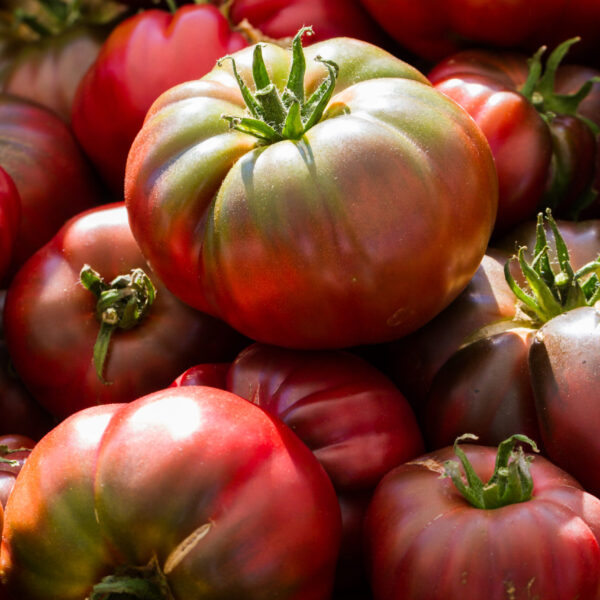
Heirloom tomatoes — your Brandywines, your Green Zebras, your Black Krims — were bred over generations by people who were selecting for one thing: taste. They’re softer, shorter-lived, and completely unbothered by your expectations of uniformity. One plant might give you fruits ranging from 60g to 300g. They might crack in summer rain. They might look like they’ve been through something.
They will, however, taste like a tomato. Often like the best tomato you’ve ever had.
Seed saving: the part that deepens your connection to growing
Here’s something worth understanding about how these systems work.
Heirloom varieties breed true — that means if you wanted to save seed from your Chioggia beet and plant it next year, you’d get Chioggia beets again. You could do that. Many gardeners do. It’s a skill, a practice, and a way of deepening your relationship with the plants you grow.
Hybrid seeds work differently. By design, the F1 magic — those specific traits you bought for — doesn’t carry forward reliably in the second generation. The offspring become unpredictable. If you want that same hybrid next year, you buy a new packet.
Neither system is wrong. But they represent different approaches to gardening — one focused on consistency and breeding for specific outcomes, the other on variety, selection, and the slow work of learning what grows best in your particular patch. Both have merit. The question is which one aligns with how you want to garden.
Genetic diversity: the quiet argument
When you grow a tray of F1 hybrid seedlings, they are, genetically, almost identical. This is the point: predictability, uniformity, consistent yield. In large-scale commercial agriculture, this makes sense. You need every plant to ripen at the same time, reach the same size, and survive the same conditions.
In your home garden, this uniformity is less useful — and in a broader sense, it’s a risk. Agricultural biodiversity, the range of genetic variation within and between crop species, is what gives farming systems their resilience. When a pest or disease arrives that can crack the defences of one plant, genetic diversity means some plants will have a different response. Monocultures — whether at field scale or garden scale- are vulnerable in ways that diverse plantings are not.
Heirloom varieties, grown open-pollinated, maintain that genetic variation. No two Brandywine tomatoes from your garden are identical at a genetic level, even if they look similar. That variation is a feature.
So which should you grow?
Both, probably. Or either, depending on what you’re trying to do.
If you want a reliable, high-yielding cucumber for a small balcony, a good F1 hybrid might genuinely serve you better. If you want to grow something with genuine flavour, discover varieties you’d never find in a supermarket, and experiment with selection, heirlooms are your path (and we have varieties suitable for container growing, too).
The point isn’t that one is morally superior. The point is that they’re different tools, bred for different purposes, and most people making garden choices don’t know enough about that difference to make an informed one.
Now you do.
What RAW grows (and why)
Every variety in the RAW range is heirloom and non-GMO. That’s a deliberate position on flavour, seed sovereignty, and what we think home gardens should look like.
A few worth growing this winter:
Beet Chioggia — an Italian heirloom with candy-cane pink and white rings. Sweet, mild, and completely unrecognisable from the supermarket alternative.
Kale Dinosaur — cold-sweetens as the temperature drops. Sow now, and it tastes better by July.
Carrot Parisian — a round, container-friendly French heirloom. Sweet, fast, and built for small gardens.

1 Comment
Love Heirloom tomatoes
Beautiful